CAPED CRUSADING
SHERLOCK HOLMES AS SUPERHERO


Victorian London produced many remarkable figures, but few possess the mythic aura of Sherlock Holmes. Holmes occupies a strange space between detective and legend. He is not a caped crusader, yet he performs feats seemingly beyond the reach of ordinary human beings. With unmatched intellect, mastery of disguise, physical courage, and an obsessive dedication to justice, Holmes operates much like a masked vigilante patrolling the fog filled streets of London. Remove the deerstalker and violin and what remains is a figure who would not look out of place beside any modern comic book hero.
One of Holmes’ most useful abilities is his command of disguise. In several cases he alters his appearance so thoroughly even close acquaintances fail to recognize him. He has the skills to become a sailor, a clergyman, a groom, a laborer, a harmless old man, and more. In A Scandal in Bohemia he passes himself off as a drunken groom in order to gather intelligence about Irene Adler. The transformation is so convincing Watson himself does not recognize his friend. This ability to vanish into another identity gives Holmes a power similar to a masked vigilante. Like a shadow in the city streets, he can move unnoticed through any level of society.
Another heroic trait lies in Holmes’ extraordinary powers of observation. A single glance allows him to reconstruct entire histories from tiny details. Mud on a trouser cuff, the wear pattern on a watch chain, or the shape of a walking stick becomes a trail of clues. When Watson first meets him, Holmes deduces the doctor has recently returned from Afghanistan. The reasoning process appears almost supernatural. Readers witness the mental equivalent of x-ray vision. Holmes does not simply look at the world. He sees through it and pieces it together.
His logic also performs feats bordering on the impossible. Many of his cases present puzzles which leave the police baffled. Yet Holmes walks into the scene, studies the fragments, and assembles a complete explanation with dazzling precision. In The Adventure of the Speckled Band he traces a bizarre locked room mystery to a venomous snake trained to crawl through a ventilator. The solution feels as dramatic as any supervillain reveal. Where others see chaos, Holmes detects design.
Physical courage also places Holmes in heroic territory. Though remembered primarily as a thinker, he is capable of swift and decisive action. He practices boxing and the martial art known as baritsu. In several confrontations he displays formidable strength and agility. During The Adventure of the Solitary Cyclist he knocks down a pursuing thug with a single punch. In other cases he leaps into danger without hesitation. Holmes may prefer a violin and a pipe, yet he can fight when justice demands it.
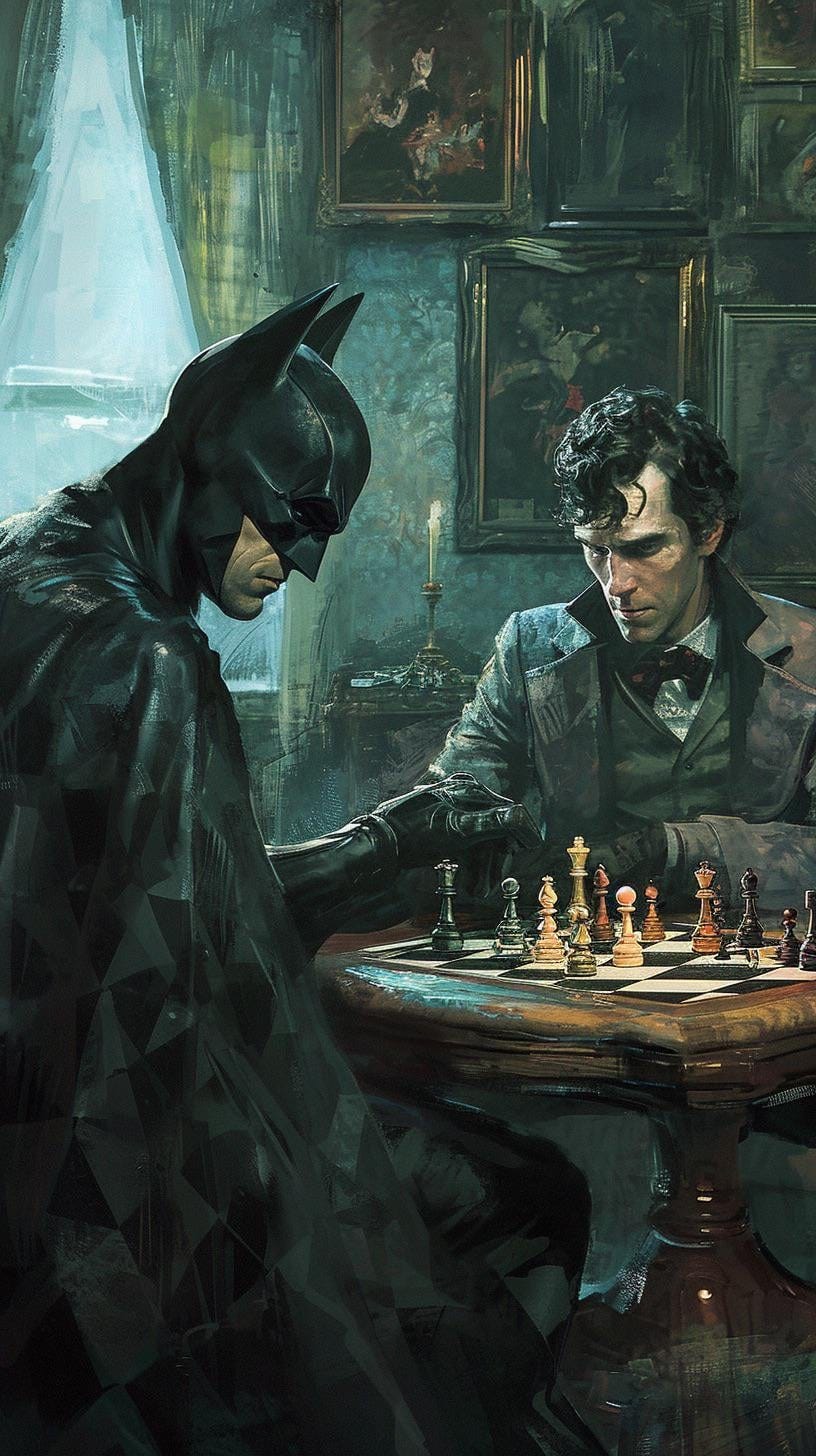
Perhaps the clearest example of Holmes as a heroic figure appears in his battle with Professor Moriarty. Moriarty serves as a criminal mastermind who commands a hidden empire of wrongdoing. Holmes describes him as a spider sitting at the center of a vast web of crime stretching across London. The conflict between the detective and this shadowy genius carries the scale of a classic superhero rivalry. Their confrontation at the Reichenbach Falls reads like the climactic clash between two titanic forces.
Holmes’ survival after the encounter strengthens the legend even further. For years the world believes he has died in the struggle with Moriarty. When he returns in The Adventure of the Empty House, Watson experiences astonishment bordering on disbelief. Holmes reveals he spent the intervening years traveling through Asia and mastering additional skills while dismantling the remnants of Moriarty’s network. The return of a hero from presumed death could easily belong to the pages of a graphic novel.
Another remarkable ability lies in Holmes’ scientific knowledge. He conducts chemical experiments, analyzes tobacco ash, and studies footprints with obsessive care. In an era before modern forensic science, he builds his own laboratory methods. These techniques allow him to extract evidence invisible to ordinary investigators. In effect he creates gadgets of the mind. His magnifying lens becomes as iconic as any hero’s specialized equipment.
Holmes also demonstrates an unwavering commitment to justice that elevates him above the role of hired investigator. He does accept payment, yet he often refuses cases lacking moral complexity. When a client seeks to hide dishonorable conduct, Holmes declines the work. On other occasions he bends the law in order to deliver a deeper form of fairness. In The Adventure of the Blue Carbuncle he allows a frightened thief to escape because punishment would destroy a life it might yet recover. This sense of moral judgment resembles the code followed by many vigilante superheroes.
His partnership with Dr. Watson adds another dimension to the heroic image. Watson serves as chronicler, ally, and loyal companion. Every great champion benefits from a trusted associate who stands beside him during moments of peril. Watson provides courage, medical aid, and human warmth to balance Holmes’ colder intellect. Together they function as a crime fighting duo navigating the alleys and drawing rooms of London.
Finally there is Holmes’ tireless energy in pursuit of truth. When a case captures his interest he works day and night without rest. He gathers evidence, interviews witnesses, performs experiments, and pursues criminals through crowded streets or lonely country lanes. The detective becomes a guardian of order in a city teeming with deception. His mission resembles the nightly patrol of a costumed protector who refuses to surrender the streets to wrongdoing.
Sherlock Holmes may lack a flowing cape or secret lair beneath a mansion, yet the spirit of heroism runs through every adventure. He disguises himself like a master infiltrator, reasons with astonishing clarity, confronts brilliant enemies, and risks his life to defend the innocent. In the gaslit world of Victorian London, that combination of intellect, courage, and relentless pursuit of justice makes Sherlock Holmes something very close to a superhero.
Paul Bishop is the author of fifteen novels, including the award winning Lie Catchers. He is also the editor of 52 Weeks 52 Sherlock Holmes Novels—a multi-author compendium of essays regarding fifty-two of the best Sherlockian pastiches plus much more—Available on Amazon or from Genius Books...
52 Weeks * 52 Sherlock Holmes Novels