DID SHERLOCK HOLMES USE DEDUCTIVE OR INDUCTIVE REASONING—OR BOTH?

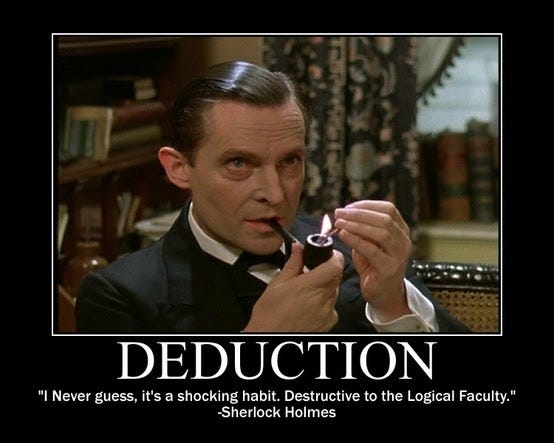
Few fictional characters have become as synonymous with sharp intellect and logical brilliance as Sherlock Holmes. From the moment he stepped onto the literary stage in Arthur Conan Doyle’s A Study in Scarlet, Holmes has captivated generations with his seemingly miraculous ability to unravel the most baffling mysteries. Central to his reputation is his method of reasoning. But what kind of reasoning does he actually use? Is Holmes the master of deductive reasoning, as so often claimed? Or is he in fact a brilliant practitioner of inductive reasoning—or a hybrid of both?
To understand Holmes’s method, we must first define the terms...
Deductive reasoning starts with a general principle or rule and applies it to a specific case to reach a logically certain conclusion. It moves from the general to the specific. For example—All humans are mortal...Socrates is a human...Therefore, Socrates is mortal. If the premises are true and the logic is valid, the conclusion is inescapable.
Inductive reasoning, on the other hand, involves making generalizations based on specific observations. It moves from the specific to the general and often deals in probability rather than certainty. For example—The sun rose today...The sun rose yesterday...Therefore, the sun will likely rise tomorrow. Inductive reasoning does not guarantee truth, but it can be highly persuasive and useful, particularly when patterns emerge.
Holmes himself—and Watson in narrations—often describes his process as deduction. In The Sign of Four, Holmes tells Watson, When you have eliminated the impossible, whatever remains, however improbable, must be the truth. This sounds impressively deductive, and it has helped cement Holmes’s image as the high priest of deductive logic.
Yet, many philosophers and logicians have pointed out that Holmes rarely uses pure deduction. Instead, he more often gathers a variety of seemingly unrelated observations and constructs a hypothesis—one that is confirmed or refined as further data emerges. This is much closer to inductive reasoning.
For example, in A Scandal in Bohemia, Holmes deduces that Irene Adler is a woman of refined habits based on the quality of her writing paper and the way she folds it. But these conclusions are drawn not from universal truths, but from repeated observations and assumptions—classic hallmarks of inductive reasoning.
To be fair, Holmes likely employs a blend of both reasoning styles. His method often begins with inductive steps—examining footprints, cigar ash, calluses, and typewriting habits—before he makes broad conclusions. These conclusions are then tested deductively, as he eliminates false hypotheses and narrows possibilities with ruthless logic.
Consider the short story Silver Blaze. Holmes notices that a dog did not bark during the night of a crime. This leads to the famous curious incident of the dog in the night-time. From this single observation, Holmes infers—inductively—the dog knew the intruder. He then deduces the only person the dog would not bark at was the horse’s owner or caretaker, leading to the culprit. This interplay between inductive insight and deductive elimination is classic Holmes.
Modern cognitive science and forensic investigation more closely resemble Holmes’ hybrid approach. Analysts gather data—inductive—form hypotheses, and then test them logically—deductive. This layered method has influenced real-world criminology and scientific reasoning, to the point some police departments still use Holmes’ cases for training exercises.
Sherlock Holmes’ brilliance, then, lies not in his rigid adherence to one system, but in his agile use of both. He observes like a scientist, hypothesizes like a philosopher, and concludes like a logician.
While Sherlock Holmes may call his method deductive reasoning, a close examination reveals that he uses a dynamic and pragmatic blend of deduction and induction. He observes patterns, forms theories, tests possibilities, and rules out falsehoods. In doing so, he exemplifies a flexible intelligence that adapts to the demands of each mystery.
Thus, Holmes is neither strictly a deductive thinker nor purely inductive. Rather, he is a master of logical reasoning in all its forms—an intuitive, empirical, and analytical genius who remains as relevant in today’s age of big data and forensic science as he was in Victorian London.