FROM CANON TO CROSSOVER
WHY SHERLOCK HOLMES IS THE ULTIMATE PUBLIC- DOMAIN PROTAGONIST

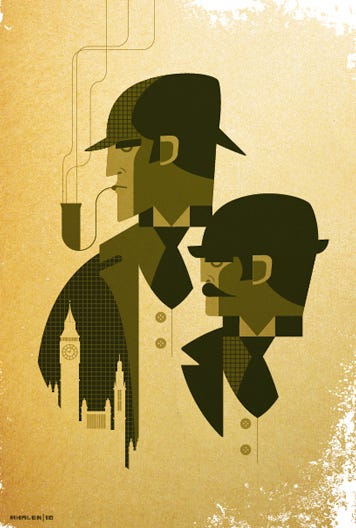
Sherlock Holmes may be the most adaptable character in literary history. He has been a Victorian gentleman, a modern consulting detective, a steampunk adventurer, a cartoon dog, an anime hero, and a globe trotting action figure. He has solved crimes in gaslit London, contemporary New York, feudal Japan, alternate timelines, and distant futures. Through all of these transformations, he remains unmistakably himself.
For writers, Holmes is more than a famous character. He is a model for how a public-domain figure can thrive across genres, eras, and mediums without losing narrative power. He is a well-designed protagonist who can survive cultural shifts and storytelling trends while remaining endlessly useful.
Holmes works because he is not defined by props or costume. The deerstalker and pipe are cultural shorthand, but they are not the engine. Holmes exists to solve impossible problems through observation, logic, and relentless curiosity. It is a function which never goes out of style. Place him in any setting and story begins to come alive—in ancient Rome he uncovers political assassinations; in a cyberpunk future he tracks digital criminals; in a horror tale he investigates cults and forbidden knowledge; in the Wild West he hunts outlaw gangs across open desert. This is what makes him a storytelling engine rather than a personality piece. The moment Holmes enters a scene, a puzzle forms around him. Writers do not need to invent his motivation. The desire to solve is already there.
His personality is strong but flexible. He is observant, obsessive, socially unconventional, emotionally guarded, and guided by a personal code of justice. These traits travel easily between genres. A noir Holmes becomes a cynical urban tracker. A science fiction Holmes becomes a systems analyst navigating massive data streams. A fantasy Holmes becomes a rational mind confronting magic. A superhero Holmes becomes a strategist who solves crimes no one else can understand.
He bends without breaking--a rare quality. Many famous characters belong to one genre and collapse when removed from it. Holmes thrives on reinvention.
A large part of his success comes from Dr. Watson. Writing a genius is difficult. Geniuses can feel distant, arrogant, or mechanical. Watson grounds Holmes in human experience. Holmes supplies brilliance and spectacle. Watson supplies empathy, humor, fear, and emotional weight. Together they form a complete protagonist. The reader experiences awe through Holmes and vulnerability through Watson.
This partnership is so effective nearly every successful adaptation keeps a Watson figure, even when renamed or reimagined. The structure works because it balances intellect with humanity. For writers, this solves the genius problem before it begins.
Holmes also benefits from something few literary characters achieve. He has escaped his author. The public version of Sherlock Holmes is now a shared cultural myth. Baker Street, Moriarty, the violin, the consulting detective, and the idea of deduction itself have become narrative shorthand. A writer does not need to explain who Holmes is. Readers arrive with expectations and curiosity already in place.
This instant recognition allows stories to begin at full speed. There is no need for origin tales. The audience knows what Holmes does and why he does it. This is the same advantage enjoyed by figures like Dracula, Robin Hood, and King Arthur, but Holmes stands apart because he appears modern even when dressed in Victorian clothing. He fits comfortably beside Batman, Doctor Who, James Bond, or the Avengers. He does not feel like a relic from another age.
The public-domain status of Holmes adds another layer of power. Writers can create novels, comics, audio dramas, games, and films without licensing barriers. There are no permissions to secure and no estates to negotiate with. Holmes belongs to everyone. This freedom invites experimentation. He can cross into horror, science fiction, fantasy, or superhero fiction without resistance.
Unlike many public-domain figures, Holmes does not carry heavy historical baggage. Robin Hood is bound to medieval England. Dracula is bound to gothic horror. Frankenstein is bound to romantic tragedy. Holmes is portable. He steps easily into modern worlds because his defining traits are rooted in intellect and inquiry rather than mythology or folklore.
Holmes also serves as a natural bridge between genres. Mystery becomes thriller. Thriller becomes horror. Horror becomes science fiction. Science fiction becomes fantasy. Holmes acts as the reader’s guide through unfamiliar territory. He does not overpower the genre he enters. He interrogates it. He asks questions that force the world to explain itself.
This is why crossovers work so well with Holmes. Whether he is facing vampires, mad scientists, alien invaders, or criminal masterminds, he remains the constant. The rules of the world may change, but his method does not.
Writers can learn a great deal from his design. Build a character around a clear narrative function. Give your character a strong but adaptable personality. Pair them with a humanizing counterpart. Root them in a myth larger than any single story. Make them flexible across genres and eras. Holmes shows great protagonists are not defined by their setting. They are defined by what they do.
More than a century after his creation, Sherlock Holmes continues to generate new stories at a pace few characters can match. He has survived empires, world wars, cultural revolutions, and technological change. He has crossed from print to radio, film, television, games, and digital media without losing relevance. He is not just a detective. He is a storytelling machine.
For writers working in the public domain, no character offers more possibility, more recognition, or more creative freedom. Holmes remains the gold standard, not because he belongs to the past, but because he keeps stepping into the future.
Paul Bishop is the author of fifteen novels, including the award winning Lie Catchers. He is also the editor of 52 Weeks 52 Sherlock Holmes Novels—a multi-author compendium of essays regarding fifty-two of the best Sherlockian pastiches plus much more—Available on Amazon or from Genius Books...
52 Weeks * 52 Sherlock Holmes Novels