IRENE ADLER PART 3
CAROLE NELSON DOUGLAS AND THE PIONEERING IRENE ADLER SERIES

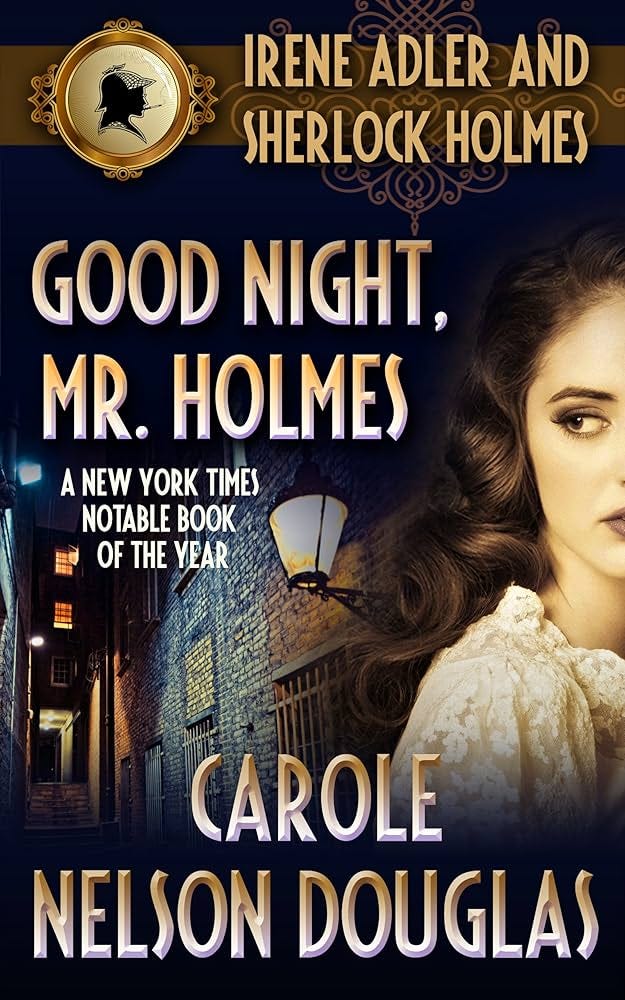
Long before Claire Andrews imagined a young adult Irene Adler for the twenty-first century with her recently released novel A Beautiful & Terrible Murder, mystery readers of the 1990s encountered a different Irene—bold, worldly, and already at the height of her powers. That Irene was the creation of Carole Nelson Douglas, whose Good Night, Mr. Holmes, published in 1990, marked the beginning of an eight-book series destined to reshape the way readers thought about the woman.
Douglas’ novels are narrated not by Irene herself, but by Penelope Huxleigh, a respectable clergyman’s daughter who becomes Irene’s companion and chronicler. In this device, Douglas cleverly captures the Holmes–Watson dynamic, but with a twist. Where Watson is often in awe of Holmes’ brilliance, Penelope brings a mix of admiration and gentle skepticism to her friend’s exploits. She is not merely a sidekick but a moral anchor and sounding board, allowing Irene to shine all the more brightly.
What emerges is a portrait of Irene as a woman of formidable intelligence, charisma, and resourcefulness. Douglas refuses to confine her to Doyle’s opera singer past or to her famous entanglement with the King of Bohemia. Instead, Irene becomes an adventuress, a detective, and, at times, a spy, moving effortlessly from the glittering salons of Europe to the darker alleys of London. She is glamorous but practical, charming but shrewd, and above all capable of solving mysteries as deftly as the Baker Street sleuth himself.
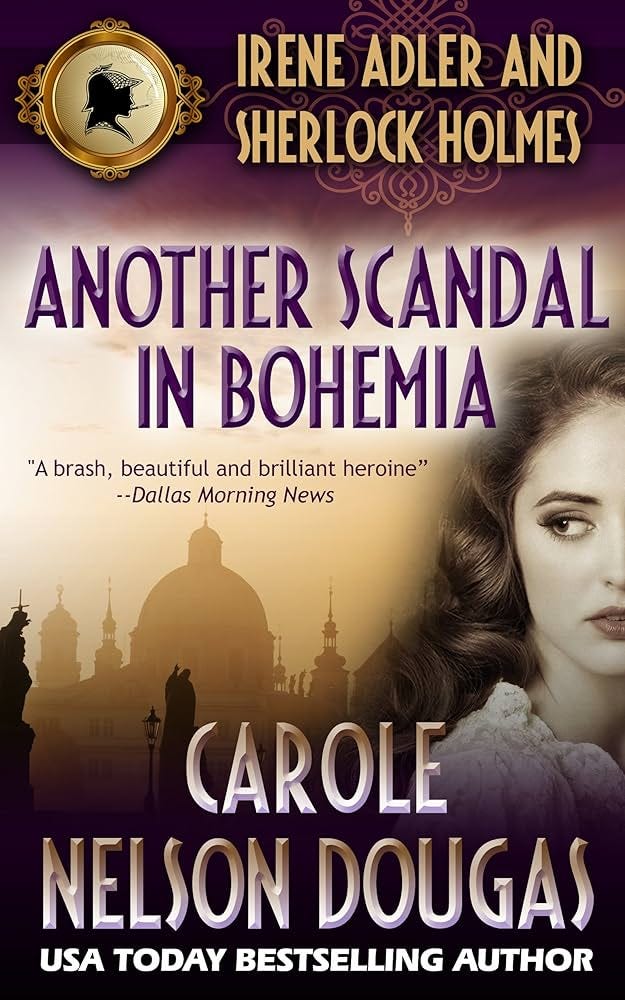
Across titles like Good Morning, Irene, Irene at Large, and Spider Dance, among others, Douglas sends her heroine through a series of intricately plotted adventures combining historical detail with fast-paced intrigue. The books are unapologetically feminist in tone, celebrating Irene’s independence and skill at a time when mystery fiction was still heavily dominated by male detectives. Douglas even allows Irene to cross paths with Holmes himself, sparring with him intellectually while carving out her own territory.
One of the striking things about the series is how it situates Irene in a broader cultural context. She is not merely a counterpoint to Holmes but a woman negotiating the constraints of her time—sexism, class barriers, the dangers of fame. Yet she is never reduced to victimhood. Instead, Douglas presents her as a model of resilience and adaptability. Whether it be opera diva, traveler, or detective, Irene inhabits those roles and others while never losing her sense of self.
For readers in the 1990s, this was revelatory. Sherlock Holmes pastiches had existed for decades, but rarely did they center women as protagonists. Irene was usually relegated to cameos, often as a love interest or femme fatale. Douglas upended those expectations, making her not only the star but also a character complex enough to carry an entire series. The success of the novels demonstrated readers were hungry for more than the usual Baker Street formula. They wanted to see what happened when the spotlight shifted.
Critics at the time praised Douglas for her historical accuracy and lively storytelling. The novels evoke the texture of the late nineteenth century while also feeling modern in their feminist undercurrents. More importantly, they established Irene Adler as more than a footnote. For the first time in popular fiction, she had her own franchise, a long-running narrative used to explored who she might have been beyond Doyle’s single sketch.
The influence of Douglas’ Irene can be traced in later works, including Claire Andrews’ most recent YA reimagining. By proving Irene could hold a series, Douglas created a precedent for others to follow. In many ways, Andrews’ A Beautiful & Terrible Murder is a younger cousin to Good Night, Mr. Holmes. Both works are born of the same impulse to reclaim Irene from the margins and make her the heroine of her own adventures.
But Douglas’s series is not the only place where Irene found new life. Beyond these two landmark reinventions, other writers have dabbled with Adler-centric stories, placing her in anthologies, stand-alone novels, and even speculative reimaginings. These less well-known works add further dimensions to her ever-expanding legend, and will be discussed in the next Sherlock Adjacent Substack blog post...
Paul Bishop is the author of fifteen novels, including the award winning Lie Catchers. He is also the editor of 52 Weeks 52 Sherlock Holmes Novels—a multi-author compendium of essays regarding fifty-two of the best Sherlockian pastiches plus much more—Available on Amazon or from Genius Books...
52 Weeks * 52 Sherlock Holmes Novels