
SHERLOCK HOLMES VERSUS MORIARTY
THE PERFECT DICHOTOMY OF GENIUS AND EVIL

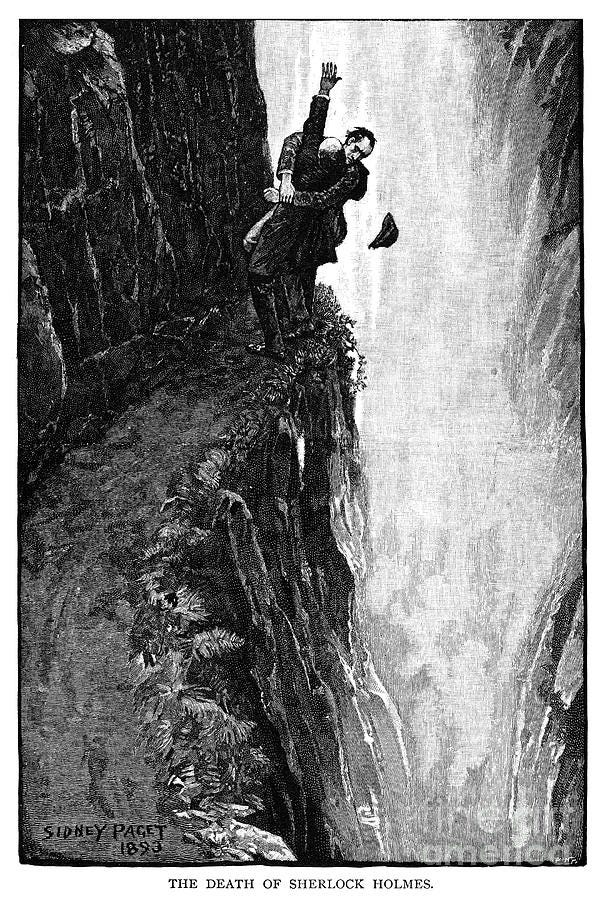
In the vast literary canon of detective fiction, few rivalries have proven as enduring, mythic, and symbolically potent as that between Sherlock Holmes and Professor James Moriarty. Though Moriarty appears directly in only The Final Problem and indirectly via flashback in The Valley of Fear, his shadow looms large over the Sherlockian mythos. Sir Arthur Conan Doyle gave readers a villain who, through the sheer power of suggestion and narrative gravitas, transcended his minimal textual presence to become a universal archetype—the criminal mastermind, the Napoleon of Crime. This dichotomy between Holmes and Moriarty—the intellectual detective and his equally brilliant criminal counterpart—has proven so compelling that it continues to shape adaptations, reinterpretations, and the very concept of hero-villain dynamics to this day.
When Doyle introduced Moriarty in The Final Problem (1893), he did so with a sense of immediacy and gravitas. Holmes describes him as a man of good birth and excellent education, a brilliant mathematician whose genius has turned toward the organization of crime rather than its prevention. Holmes claims Moriarty controls a vast criminal network, operating behind the scenes, never committing crimes himself, but orchestrating them with cold, mathematical precision.
Crucially, Doyle uses Moriarty to craft what is essentially Holmes’ mythic death in The Final Problem. The story is not just about solving a crime; it is about the existential confrontation between good and evil, logic and chaos, order and entropy. By positioning Moriarty as Holmes’ intellectual equal—and perhaps even superior in raw mental calculation—Doyle amplifies Holmes’ own stature. A hero is often defined by the caliber of his antagonist, and in Moriarty, Holmes finds the mirror image of himself, corrupted.
Although The Valley of Fear gives readers a glimpse into Moriarty’s wider influence, he remains more phantom than presence. Even his name evokes dread not because of deeds witnessed directly, but because of the awe in which Holmes—and by extension, the reader—is meant to hold him. Doyle’s restraint in utilizing Moriarty paradoxically magnifies the character’s impact—less is more. This aura of mystery, menace, and magnitude becomes foundational for Moriarty’s legacy.
Moriarty’s role goes far beyond being merely a formidable opponent. He serves as a narrative device through which Holmes is humanized. In most Holmes stories, the detective is cool, clinical, and always several steps ahead. He often dismisses Scotland Yard, outwits murderers, and unravels mysteries with an almost superhuman detachment. But with Moriarty, Holmes is vulnerable. He sweats. He runs. He plans to flee England. He nearly dies.
This confrontation also allows Doyle to explore broader themes—the limits of rationalism, the dangers of unchecked intellect, and the thin line between genius and madness. If Holmes represents reason harnessed for justice, then Moriarty is reason corrupted by ambition and greed. The two men are cut from the same cloth but tailored for different purposes.
Moreover, the showdown at the Reichenbach Falls becomes a symbolic death and rebirth. Doyle had intended The Final Problem to be Holmes’ swan song, and Moriarty, as an adversary of unparalleled magnitude, provided the justification for Holmes’ sacrifice. Though public demand later forced Doyle to resurrect Holmes in The Adventure of the Empty House, the mythic status of Moriarty remained untouched.
Despite his sparse appearances in Doyle’s texts (while only appearing in two stories, he was alluded to in five others), Moriarty has grown into an ever-expanding presence in Sherlockian fiction. Pastiches, radio plays, films, and television have all reimagined and reinvented him—sometimes preserving his cold intellectualism, other times portraying him as a sadistic monster, a government agent, and other more radical reinterpretations.
This enduring flexibility speaks to the symbolic weight Moriarty carries. In Granada Television’s celebrated adaptation starring Jeremy Brett, Moriarty is portrayed as a suave but ruthless manipulator, given just enough screen time to cast a long shadow. In the BBC’s Sherlock, Andrew Scott’s portrayal of Moriarty is theatrical, anarchic, and psychopathic—a postmodern reimagining for the digital age. In Guy Ritchie’s Holmes films starring Robert Downey Jr., Moriarty is again the intellectual puppet-master, now with economic warfare as his battleground. Even animated and parodic versions—such as Moriarty appearing in anime, children’s cartoons, or comedic skits—demonstrate the character’s adaptability and widespread cultural penetration.
More than just a man, Moriarty has become a concept: the nemesis who represents the absolute limit of a hero’s challenge. When modern writers seek to craft a Holmes vs-style story, Moriarty often becomes the natural choice of villain, even in stories where he never originally appeared. The Holmesian canon has been expanded to include tales set before The Final Problem, imagining their prior encounters. Stories such as John Gardner’s The Return of Moriarty, Kim Newman’s Moriarty: The Hound of the D’Urbervilles, and Anthony Horowitz’s authorized novel Moriarty dive deep into the villain’s psyche and motivations, treating him as an antihero in his own right.
One of the most fascinating aspects of Moriarty’s legacy is how he continues to exist and evolve even without Holmes as a foil. He has become a fixture in literature and pop culture as the archetypal mastermind, influencing characters such as Ernst Stavro Blofeld in the James Bond series, Lex Luthor in Superman, and even modern tech villain figures in cyber-thrillers. The concept of the shadow genius, the hyperintelligent antagonist lurking in the background, directing chaos, can almost always trace a line back to Moriarty.
In some modern adaptations, Moriarty has become the protagonist, as seen in manga and anime like Moriarty the Patriot, where he is re-envisioned as a revolutionary antihero determined to overthrow class oppression in Victorian England. This kind of inversion reflects society’s shifting values—where the villain may now represent social critique rather than pure evil—and shows how Moriarty, like Holmes, is a literary character fluid enough to reflect contemporary concerns.
Professor Moriarty is not simply a character; he is an idea—an eternal counterbalance to Holmes’ righteousness and logic. Within Doyle’s relatively restrained use, he serves to elevate the stakes and give Holmes a worthy foe. Beyond the canon, Moriarty has become a cultural touchstone for criminal intellect, endlessly interpreted and reimagined, often carrying symbolic significance well beyond the realm of detective fiction.
Ultimately, the duel at the Reichenbach Falls is not just the climax of a detective story—it is the meeting point of good and evil at their most rarefied heights. In pitting Sherlock Holmes against James Moriarty, Doyle gave us not just a memorable clash, but an archetype—the genius and the madman, locked in perpetual struggle, destined to fall together, and to rise again in the imaginations of each new generation.
Another fantastic piece, Paul. One thing I'll suggest is (and it's just an opinion, rather than a hard fact) in the mind of the fans, that Moriarty took time to grow into the colossus of crime. If you look at some of the fin-de-seicle movies and plays—particularly the un-authorized ones—Raffles was more often than not the villain in Holmes stories. But over time, Moriarty grew in stature, and these days Raffles is largely forgotten.
Good stuff. It's also a turning point in Holmes's life. This is the only time in his career in which he's taken a life. He comes back chastened more humane I think.