
SHERLOCK'S GENRE OFFSPRING

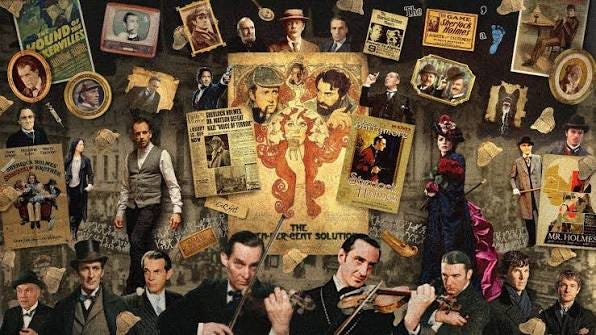
There is a moment in nearly every crime novel written in the last hundred years when you can feel the ghost. It is not always obvious. Sometimes it announces itself plainly—a brilliant eccentric who notices what everyone else has walked past, a long-suffering partner doing his best to keep up, a police force too bound by procedure to see what the outsider sees immediately. Other times it is subtler—a detective who uses silence as a weapon, or a scene where the solution to the crime is visible on the first page to anyone paying the right kind of attention. The ghost, of course, is Sherlock Holmes. And the writers summoning him often have no idea they are doing it.
Arthur Conan Doyle published A Study in Scarlet in 1887, and the argument could be made he has not stopped publishing since. Not personally, obviously. But the machine he set in motion has never stopped running. Every year, hundreds of crime novels appear on shelves and in digital catalogs, and a significant portion contain DNA traceable to Baker Street. The question worth sitting with is not whether this is true—because it plainly is—but why it continues to be true. Why, after more than a century of crime fiction, are writers still circling the same original lightning strike?
Part of the answer is structural. Holmes solved problems no one had solved in the same way. Detective fiction existed prior to Doyle—Poe’s Dupin being the most obvious predecessor—but Holmes was the first to make the detective’s mind the primary spectacle. The mystery was secondary. What readers came for was the pleasure of watching a particular kind of intelligence operate in real time—a mind working differently from their own. Watson was the lens. Through him, readers understood enough of the method to feel the wonder without it collapsing into explanation.
The combination of brilliant observer, humanizing companion, and a puzzle constructed so the reader is always one step behind until the reveal was not a formula. It was a discovery specific to what readers actually want from this kind of story. Doyle found something genuinely true about the reading experience, and truth, once found, tends to get reused.
The television landscape makes this especially visible. Sherlock, the BBC series arriving in 2010, made no effort to disguise its lineage, choosing instead to celebrate it. The show transplanted Holmes and Watson into modern London and watched what happened when contemporary technology met Victorian observation. What the show understood, and what its success confirmed, is the relationship between the two characters is more durable than any period setting. Holmes is still Holmes because Watson is still Watson.
Elementary did something similar on the other side of the Atlantic. It also went further by making Watson a woman, which changed the emotional texture of the partnership without touching the essential structure underneath. Monk gave Holmes obsessive-compulsive disorder and a backstory soaked in grief. House, M.D. moved him into medicine and spent eight seasons demonstrating the formula works as well when the mystery is a failing body rather than a crime. The names changed. The bones did not.
What is interesting is how infrequently the writers and showrunners behind these productions experience this as derivation. They experience it as discovery. They find their way to a particular kind of character—a hyper-perceptive, socially problematic, morally idiosyncratic figure who needs someone steady beside them to function in the world—and it strikes them as invention. This is not dishonest. It is recognition of a character type so deeply embedded in the genre’s imagination it seems natural rather than borrowed. Holmes has become less a specific character than a mode of being for fictional detectives. He is the archetype the form has taken.
Doyle himself would probably find this more amusing than flattering. He grew famously tired of Holmes, killed him at the Reichenbach Falls in 1893 and spent a decade trying to keep him dead, only to bring him back because the reading public refused to let the character go. He had not understood the depth of what he had built. Or perhaps he understood it too well and resented it. The creation had outgrown the creator.
This has happened only a handful of times in literary history, and each time it does, the character stops belonging to its author and starts belonging to everyone. Today, Holmes is in the cold case detective who does not play well with others. He is in the forensic specialist who communicates in data and struggles with small talk. He is in every scene where a detective crouches over something tiny and explains, with quiet certainty, what everyone else in the room missed. He is in the structure of partnerships—the question of who anchors whom, and what the dynamic does for the story being told.
Crime fiction is a genre preoccupied with disorder and its resolution. Holmes was the first great answer to this preoccupation. A century and a half later, writers keep reaching for Holmes not because they lack imagination, but because the answer he provided was genuinely good. Good answers don't expire. They just change address.
One the elements I truly enjoyed and found fitting in SHERLOCK is how Watson could only take so much of Holmes before he found him so insufferable he was compelled to attack him physically, as in "The Empty Hearse". When Holmes revealed to Watson he was still alive and had faked his death, instead of fainting, an enraged Watson literally went for his throat.