
WHEN LEGENDS ALIGN
THE DETECTIVE AND THE BATMAN...

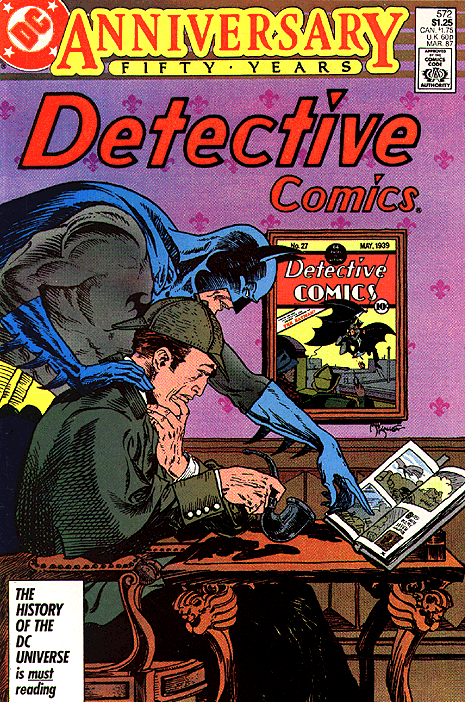
In the vast multiverse of fiction, few alliances feel as inevitable—and as intellectually thrilling—as that of Sherlock Holmes and Batman. Both are icons of deductive brilliance, psychological depth, and moral conviction. Born nearly half a century apart—Holmes in 1887 and Batman in 1939—they each redefined the mystery genre in their own eras. Their respective creators, Sir Arthur Conan Doyle and Bob Kane (alongside Bill Finger), infused them with traits that transcended genre—Holmes, the coldly brilliant Victorian sleuth, and Batman, the brooding protector of Gotham.
Over time, their mythologies have evolved to near-legendary proportions, and inevitably, the minds behind modern storytelling could not resist bringing these two together. Their crossovers, while rare, offer compelling studies in how narrative legends can blend across centuries and mediums.
In 1987, DC celebrated the 50th anniversary of Detective Comics, the very series that gave Batman his debut in issue #27. To honor this legacy, Detective Comics #572 was crafted as a special celebratory story—a one-shot featuring a star-studded team-up of Batman, Robin, Elongated Man, Slam Bradley, and...Sherlock Holmes.
Partially written by Mike W. Barr and illustrated by Alan Davis along with others, The Doomsday Book is a globe and time-spanning tale in which an ancient manuscript (the titular Doomsday Book) holds the key to a far-reaching conspiracy. The story alternates between the present and the past, eventually culminating in a meeting between Batman and an aged but still brilliant Sherlock Holmes.
Set in contemporary Gotham, Batman and his allies investigate a murder connected to the book, which has been targeted by a shadowy criminal organization. In a climactic moment, Batman follows clues to a hidden estate in England—only to find Holmes, living in secret retirement (a respectful nod to Conan Doyle’s The Lion’s Mane and His Last Bow).
Though Holmes is aged, he is still mentally sharp, and the dialogue between him and Batman is one of admiration and mutual respect. Holmes recognizes in Batman a successor of sorts—an evolution of his methods in a darker, more violent age. Batman, for his part, defers to Holmes as the original and perhaps greatest detective.
Detective Comics #572 marked the first canonical crossover of Batman and Holmes. It celebrated not only Batman’s roots in detective fiction, but also the literary lineage that preceded him. The story honored Holmes as an archetype, a founding stone in the mythology of crime-solving heroes. For fans and scholars alike, it was a reminder that modern superheroes owe much to Victorian-era sleuths.
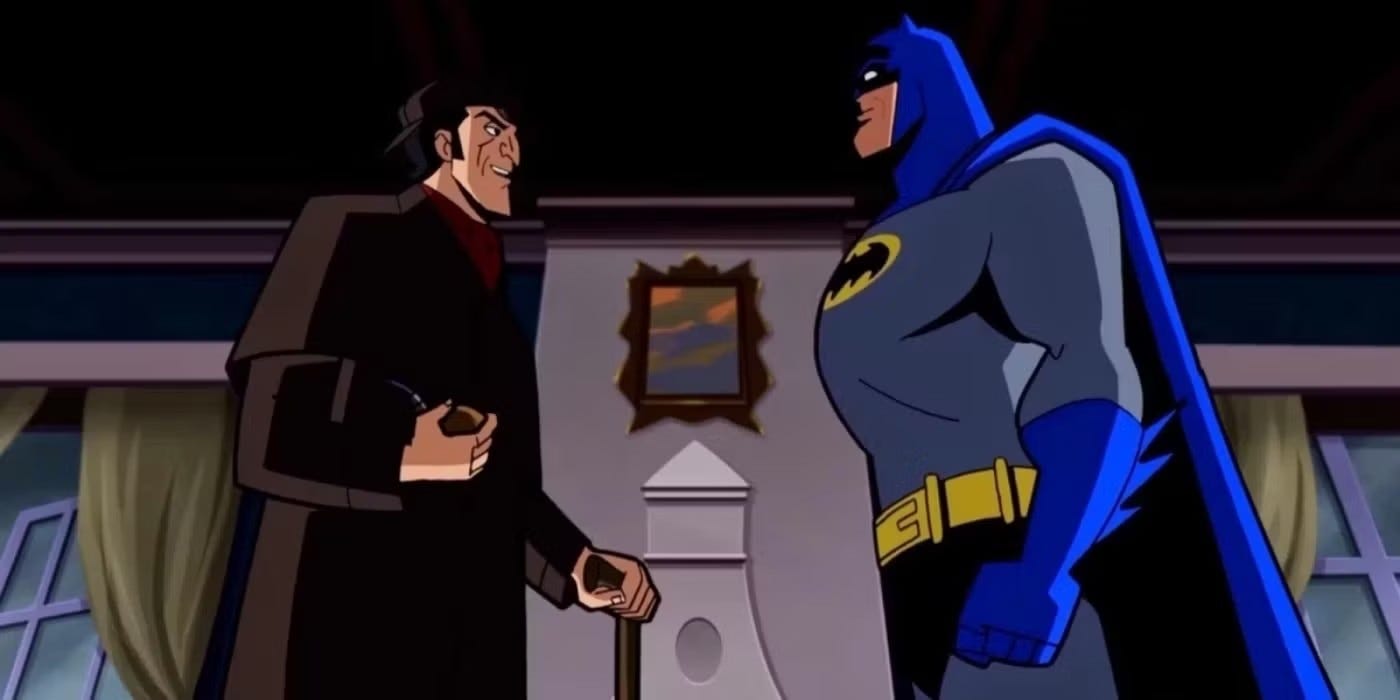
The 2009 animated series Batman: The Brave and the Bold was known for its light-hearted tone, Golden Age sensibility, and frequent crossovers with lesser-known DC characters. Yet one of its most memorable episodes took an unexpected detour into the gothic. Trials of the Demon! features Batman traveling back in time—through the aid of Jason Blood (aka Etrigan the Demon)—to 19th-century London. There, he meets the young and brilliant detective Sherlock Holmes. Together, they must clear Jason Blood’s name, as he is accused of witchcraft and murder during a spate of occult crimes.
Holmes, voiced by Ian Buchanan, is portrayed faithfully—cerebral, polite, slightly aloof, but ultimately open-minded, even when confronted with time travel and supernatural elements. The two detectives work seamlessly to uncover the true villain—Jim Craddock, the Gentleman Ghost, who has been manipulating events for his own spectral benefit.
While tonally lighter than Detective Comics #572, the episode cleverly blends elements of Holmesian mystery with Batman’s own gothic mythos. The foggy streets of London, Holmes’ reliance on deduction, and Batman’s steely pragmatism form a compelling trinity of visual and narrative atmosphere.
Notably, the episode features a subtle inversion of the usual dynamic—Holmes, still early in his career, learns from Batman just as Batman learns from him. The influence runs both ways, suggesting that while Holmes came first chronologically, Batman's legacy travels backward as well as forward.
Though an animated episode, Trials of the Demon! cemented Holmes’ place in the extended Bat-mythos. It introduced a new generation to the idea that Batman and Holmes could, and perhaps should, exist in a shared fictional tradition. The episode is frequently cited as a fan favorite and is notable for its authentic portrayal of Holmes’ deductive process alongside Batman’s.
Though separated by genre, tone, and era, Sherlock Holmes and Batman are, in many respects, reflections of the same heroic archetype. If Holmes is the father of modern detective fiction then Batman is its darkly mythic evolution. Their two canonical crossovers—in Detective Comics #572 and Batman: The Brave and the Bold—are more than narrative curiosities. They are celebrations of a literary lineage, meditations on justice, and tributes to the enduring power of intellect and morality.
When Holmes and Batman stand side by side—whether under gaslight or bat-signal—they remind us that in the face of chaos, truth, reason, and courage are timeless weapons. Their partnership may be fictional, but its resonance is very real.
Paul Bishop is the author of fifteen novels, including the award winning Lie Catchers. He is also the editor of 52 Weeks 52 Sherlock Holmes Novels—a multi-author compendium of essays regarding fifty-two of the best Sherlockian pastiches plus much more—Available on Amazon or from Genius Books...
52 Weeks * 52 Sherlock Holmes Novels
Mike Kaluta’s cover art for Detective Comics #572 was reused (and recolored) for use on 𝘋𝘊’𝘴 𝘎𝘳𝘦𝘢𝘵𝘦𝘴𝘵 𝘋𝘦𝘵𝘦𝘤𝘵𝘪𝘷𝘦 𝘚𝘵𝘰𝘳𝘪𝘦𝘴 𝘌𝘷𝘦𝘳 𝘛𝘰𝘭𝘥, a trade paperback that includes “The Doomsday Book” story in its entirety.